
Pilgrim's Guide
A complete pilgrim's guide to Tiruvannamalai
Everything you need — darshan timings, Girivalam, Karthigai Deepam, the ashrams and practical travel tips. Written by a family that lives at the foot of the hill.
Panchabhoota Sthalam · Agni Kshetram
The sacred town of Tiruvannamalai
Tiruvannamalai is one of the five great Shiva temple towns, where the Lord manifests as Agni — the element of fire. The sacred hill of Arunachala, visible from across the town, is itself considered a form of Shiva. Whether this is your first visit or your fortieth, this guide will help you make the most of your pilgrimage.
Panchabhoota Sthalam — Fire
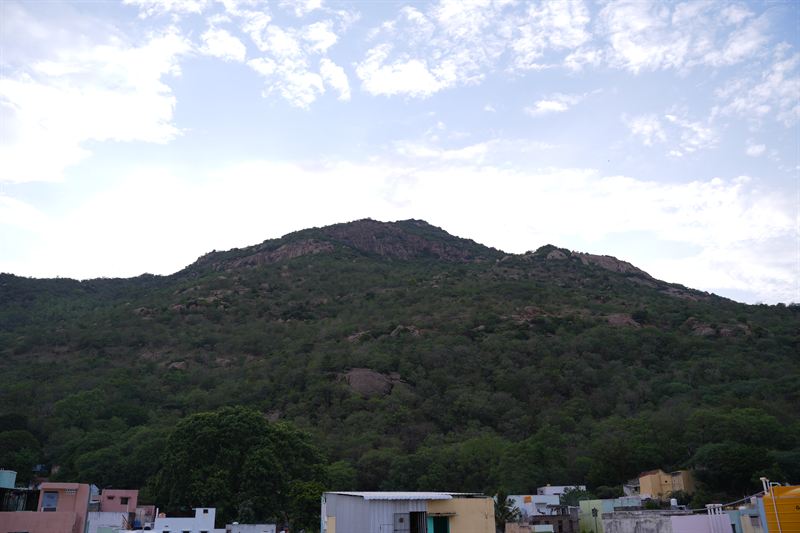
Arunachala — the hill that is Shiva
Arunachala is not merely a hill with a temple beside it. In the Shaiva tradition, the hill itself is Shiva, manifesting as a column of fire. It is one of the five Panchabhoota Sthalams — sacred temples where Shiva embodies each of the five elements. Here he is Agni (fire), and the name Arunachala means "the hill of dawn-red fire."
The hill rises to 2,682 feet (819 m) and is visible for miles. For devotees, simply seeing the hill is considered darshan. The great sage Ramana Maharshi came to Tiruvannamalai at the age of 16 and never left, declaring that Arunachala was the direct form of the Self. He spent nearly two decades meditating in the hill's ancient caves.
Meditation retreats on Arunachala
The caves on the hill
The slopes of Arunachala are dotted with caves and rock shelters that have served as meditation retreats for centuries. The most revered are those lived in by Ramana Maharshi, who spent nearly two decades on the hill before establishing Sri Ramanasramam below.
Virupaksha Cave
Located on the southern slope, Virupaksha Cave was Ramana Maharshi's home from 1899 to 1916 — over 16 years. The cave is still open for meditation and is reached by a path from the Ramana Ashram. Allow 30–45 minutes for the climb.
Skandashram
Higher up the hill, Skandashram was Maharshi's residence from 1916 to 1922. It overlooks the entire town and offers sweeping views of Arunachala's slopes. The path from Virupaksha Cave continues up to Skandashram.
Tip: Start the climb before 8 AM in summer. Allow 2–3 hours for a round trip to Skandashram. Carry water and wear sturdy footwear.
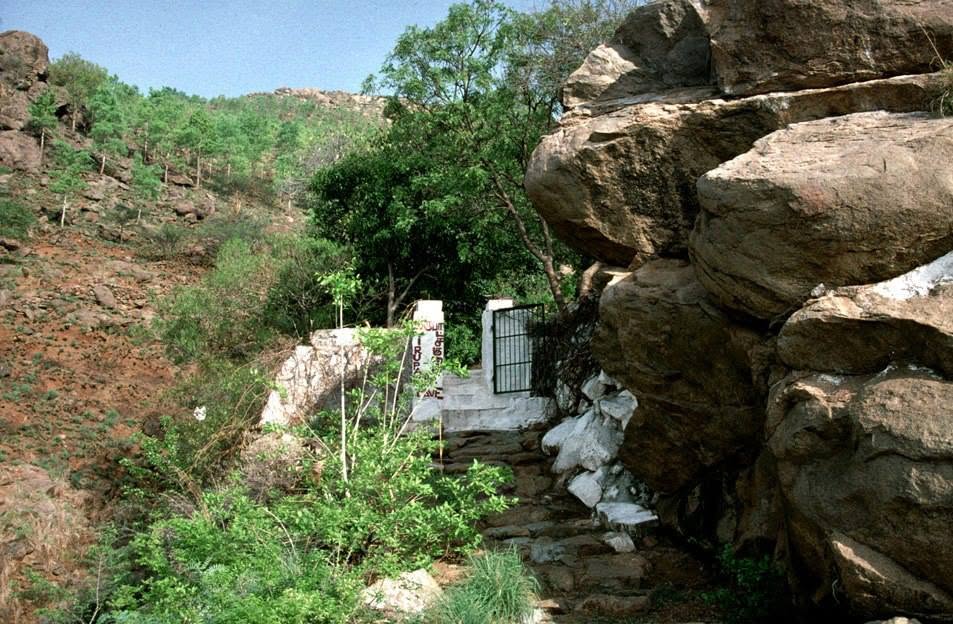
Virupaksha Cave — Ramana Maharshi's home on Arunachala for 16 years
Arunachaleswarar · Annamalaiyar
Temple darshan — timings, dress code & what to expect
The Arunachaleswarar Temple (also known as the Annamalaiyar Temple) is one of the largest temple complexes in India, covering 25 acres (10 hectares) at the foot of Arunachala. Dedicated to Lord Shiva as Agni, it is one of the most important pilgrimage sites in Tamil Nadu and draws millions of devotees each year.
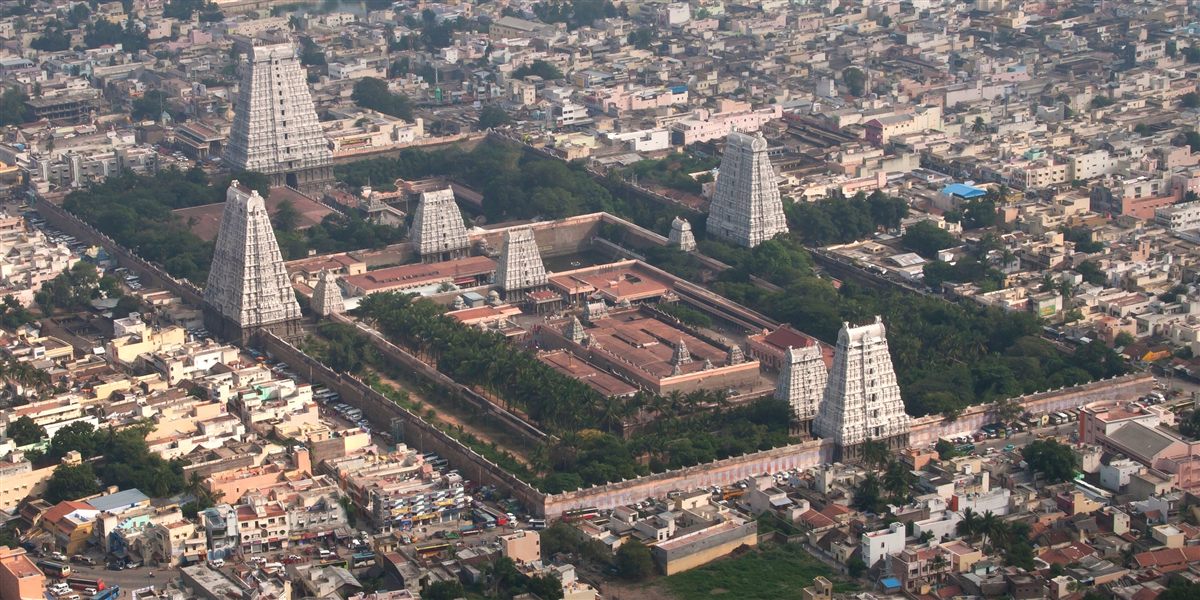
The four rajagopurams
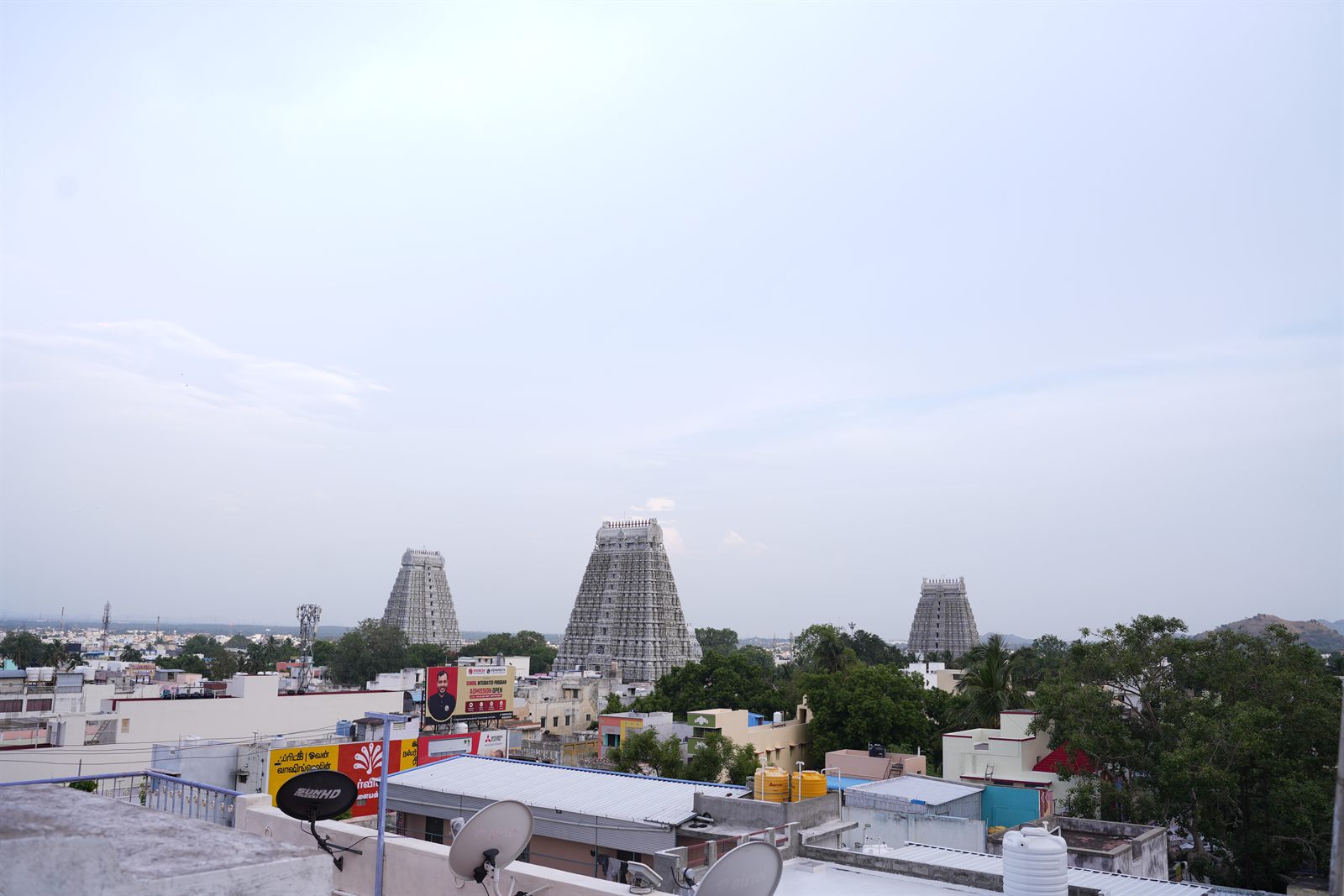
The temple's four monumental rajagopurams (gateway towers) face the four cardinal directions. The eastern gopuram is the tallest at 66 metres with 11 stories — one of the tallest temple towers in South India. All four gopurams are visible from across the town. From the rooftop of Ilayanar Home Stay, you can see three of the gopurams clearly.
Darshan timings
| Session | Opens | Closes |
|---|---|---|
| Morning | 5:30 AM | 12:30 PM |
| Evening | 3:30 PM | 9:30 PM |
Timings vary on festival days and Pournami nights. Verify locally on arrival.
Key shrines inside
- Annamalaiyar — the main Shiva lingam in the innermost sanctum
- Unnamalai Ambal — the presiding goddess (Parvati) shrine
- 1,000-pillar mandapam — a magnificent sculptural hall
- Brahma Theertham — the sacred tank used for ritual bathing
- Patala Lingam — a highly sacred underground shrine
Dress code (strictly enforced at inner sanctum)
Men: dhoti or pant — no shorts, lungi or sleeveless. Women: saree, salwar kameez or similar. Dhoti rental is available near the entrance. Remove footwear before entering the gopuram gates. Large bags must be deposited at the cloak room near the east gopuram.
Photography: Permitted in the outer precincts and gopurams. Not permitted near the main lingam or inside the inner sanctum during puja.
Paid darshan (₹50–100): A separate faster queue is available, especially useful on Pournami nights and festival days.
Giri Pradakshina
Girivalam — the sacred 14 km circumambulation
Girivalam (Giri Pradakshina) is the sacred walk around the base of Arunachala — approximately 14 kilometres, walked barefoot in a clockwise direction, traditionally beginning and ending at the eastern gopuram. It is one of the most powerful spiritual practices at Tiruvannamalai.
Pilgrims pause at eight sacred shrines — the Ashta Lingams — placed at the eight compass points around the hill, each representing a directional guardian deity.
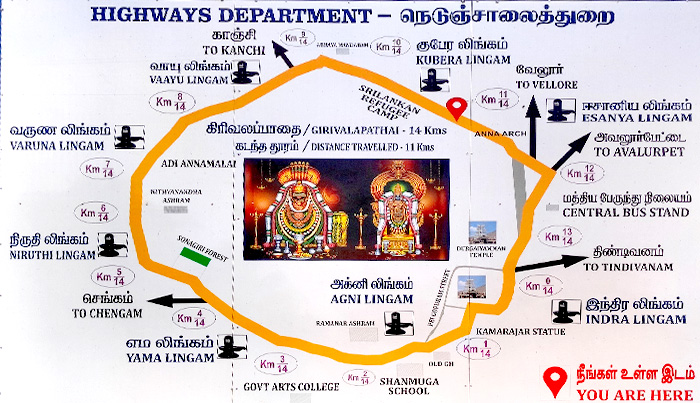
Pilgrims on the Girivalam circumambulation path, Tiruvannamalai
When & how to walk
- Pournami (full moon) night is the most auspicious — lakhs of pilgrims walk through the night in a moving river of devotion, lamps and chanting
- Any day is meritorious — local devotees walk it daily
- Start before 6:00 AM for a cool morning walk, or begin after 6:00 PM to avoid midday heat
- Allow 3 to 5 hours depending on pace and stops
- Walk clockwise (pradakshina direction) — do not reverse
What to bring
- Water — at least 1.5 litres per person (stalls available every 2–3 km)
- Small bag for offerings: flowers, camphor, incense
- Torch or phone flashlight for night walks
- Snacks or energy food for the journey
- Charged phone with offline map downloaded
- Slippers as backup (the road is walkable barefoot; the path edge has stones)
Starting from our doorstep: Ilayanar Home Stay is directly on the Girivalam Padhai. Step out of our gate and begin walking — no transport needed. Ideal for early-morning starts, even for elderly guests.
The eight Ashta Lingams
These eight sacred shrines are the spiritual milestones of the Girivalam. Each faces a specific compass direction and represents one of the eight directional guardians of Hindu cosmology.
East · Indra
Indra Lingam
Located near the main eastern gopuram — the traditional starting point of the Girivalam. Associated with Indra, king of the devas and guardian of the east.
Southeast · Agni
Agni Lingam
Represents the fire element, echoing Arunachala's own identity as the Agni Sthalam of the Panchabhoota Sthalams. Associated with Agni, the fire deity.
South · Yama
Yama Lingam
Associated with Yama, lord of dharma and death. Situated on the southern stretch near the Ayyankulam tank — one of the more prominent shrines on the path.
Southwest · Niruthi
Niruthi Lingam
Guardian of the southwest. A quieter, more meditative stop away from the main road, set in a peaceful corner of the circumambulation route.
West · Varuna
Varuna Lingam
Associated with Varuna, lord of cosmic waters and the west. Located on the long western stretch of the Girivala Padhai with open views of the hill.
Northwest · Vayu
Vayu Lingam
Dedicated to Vayu, the wind deity and guardian of the northwest. The path here offers views of the hill's rocky northwestern face rising steeply above.
North · Kubera
Kubera Lingam
Lord of wealth and guardian of the north. His lingam is near Adi Annamalai temple on the northern arc — an ancient Shiva temple that predates the main complex.
Northeast · Isanya
Isanya Lingam
The final lingam before returning to the east gopuram, representing Isanya — Shiva himself as lord of the northeast. Completing this closes the full pradakshina.
Tamil month of Karthigai
Karthigai Deepam — the festival of fire
Karthigai Deepam is the greatest festival of Tiruvannamalai, typically falling in November–December on the full moon of the Tamil month of Karthigai. It is one of the largest religious gatherings in all of Tamil Nadu, drawing millions of pilgrims.
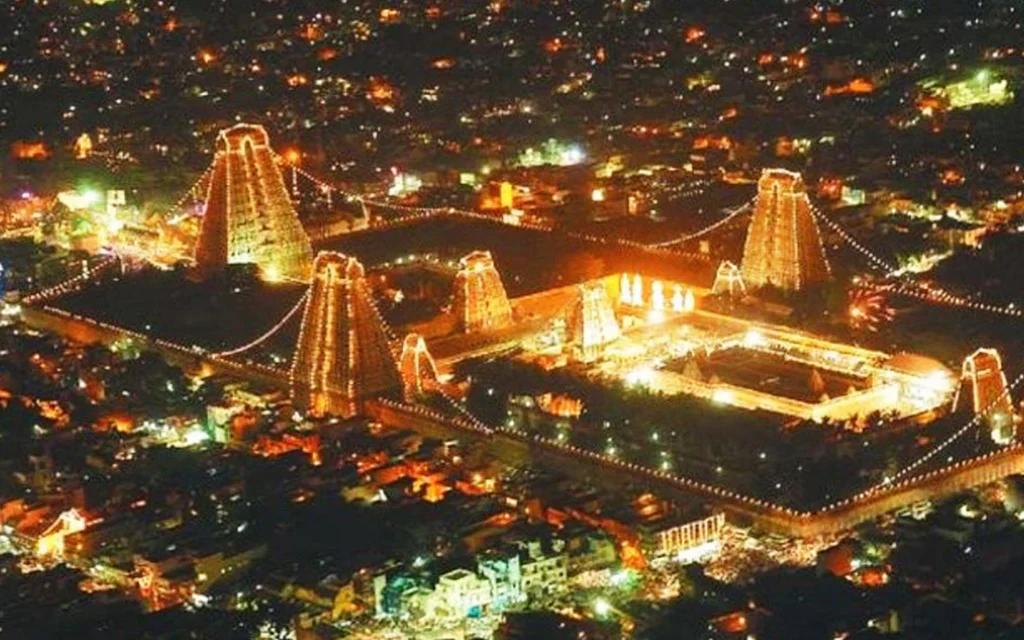
The Mahadeepam
On the full moon night, a massive camphor beacon — the Mahadeepam — is lit on the summit of Arunachala. It is prepared using a large cauldron of camphor, ghee and wicks. The flame is considered to be Shiva himself — a column of divine fire rising from the peak — and is visible for many miles around, burning through the night.
Bharani Deepam
The day before the Mahadeepam is Bharani Deepam. On this morning, a sacred flame is lit inside the innermost sanctum of the temple in absolute darkness, before the lingam is unveiled. This is considered extraordinarily auspicious, and pilgrims queue from the early hours for this darshan.
The 10-day festival
Karthigai Deepam is a full 10-day celebration with daily processions, chariot festivals, temple rituals and Girivalam walks, culminating on the Mahadeepam night. Each day has its own significance in the temple calendar.
View from our terrace
The Mahadeepam flame is visible directly from the rooftop of Ilayanar Home Stay — a rare, private and elevated view above the crowds below. These are our busiest nights of the year. Please book several months in advance for Karthigai Deepam.
Tips for the festival
- Arrive at least a day before the main Deepam night — the town fills completely
- Accommodation books out months ahead; plan early
- Keep children and elderly family members close — crowds are very large
- Watch the flame from an elevated vantage point for a calmer experience
- Carry identification and note your accommodation phone number on yourself
Meditation · Satsang · Peace
The ashrams of Tiruvannamalai
Tiruvannamalai has long attracted saints and seekers. Several revered ashrams at the foot of Arunachala are open to pilgrims of all backgrounds for meditation, satsang and the quiet spiritual atmosphere that permeates the town.
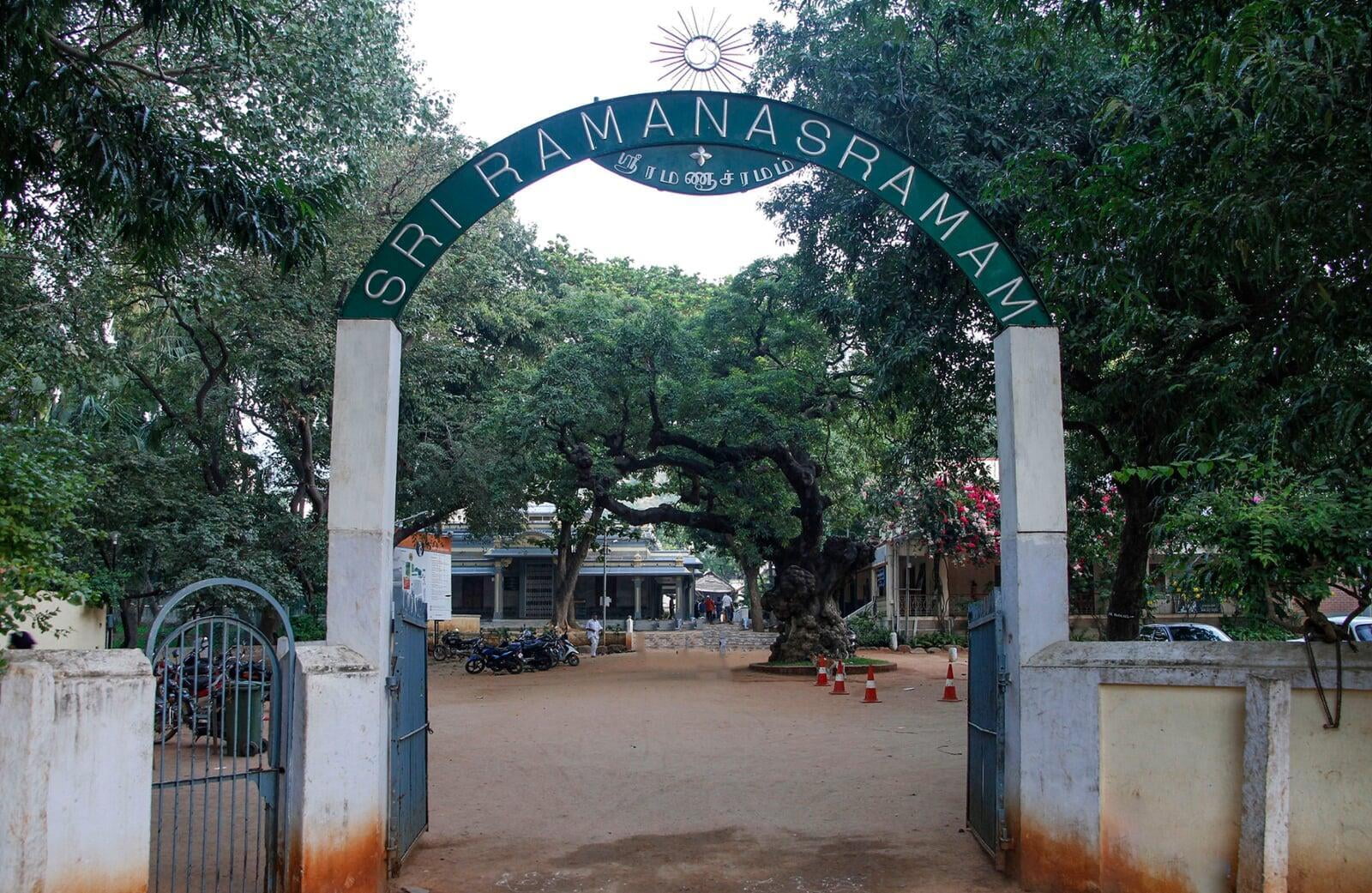
Sri Ramanasramam
Sri Ramanasramam, Tiruvannamalai
The ashram of Bhagavan Sri Ramana Maharshi (1879–1950). Its heart is the samadhi shrine — a deeply serene meditation hall. The ashram offers free meals (annadanam) to all pilgrims daily, morning and evening chanting sessions, a bookshop and library, and a path up to Virupaksha Cave and Skandashram. All are welcome, of all faiths.
- Open daily 8 AM–12:30 PM & 2–6:30 PM
- Free meals served at fixed timings
- Silence in the samadhi hall
- ~1.5 km from Ilayanar Home Stay
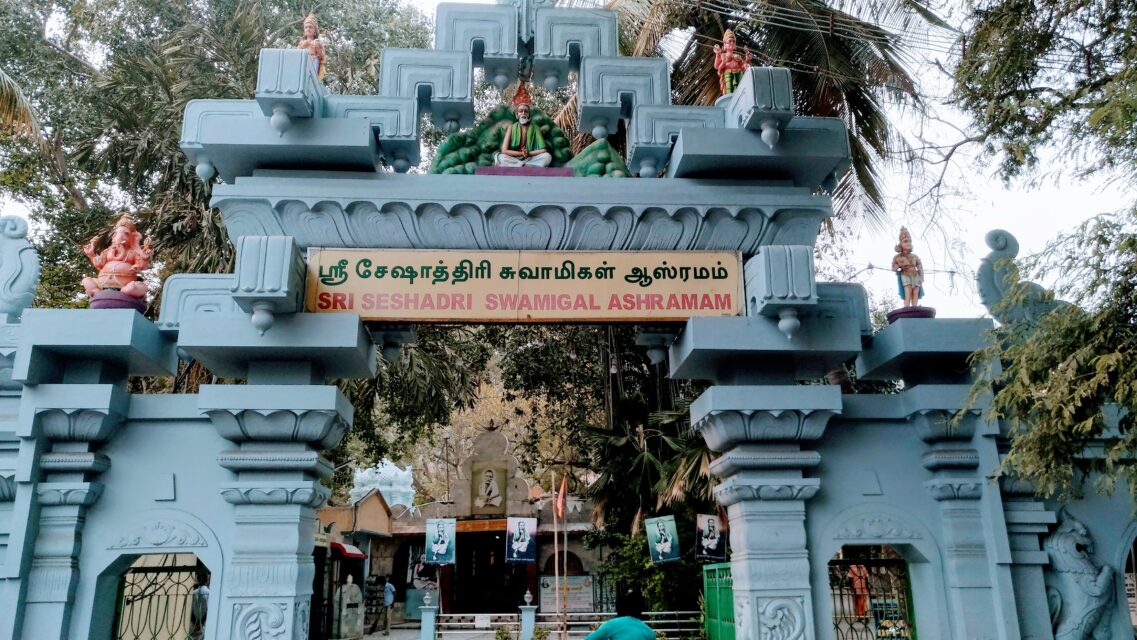
Sri Seshadri Swamigal Ashram
Dedicated to Sri Seshadri Swamigal (1870–1929), a great sage who lived in Tiruvannamalai as a contemporary of Ramana Maharshi. Known for his wandering, cryptic and playful manner, Seshadri Swamigal was revered as a divine fool-saint. A samadhi shrine and small temple mark his resting place.
- Adjacent to Sri Ramanasramam
- Open to pilgrims of all faiths
- ~1.5 km from Ilayanar Home Stay
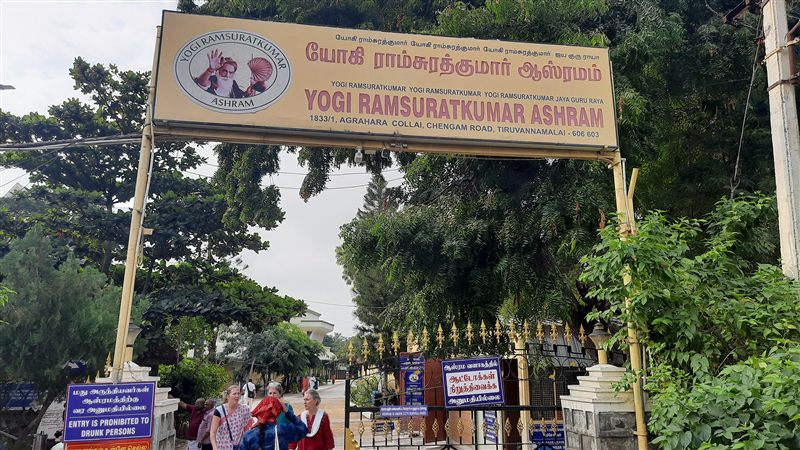
Yogi Ramsuratkumar Ashram
Yogi Ramsuratkumar (1918–2001) — the "Godchild of Tiruvannamalai" — wandered the streets as a beggar-mystic for decades before being recognised as a great master. He was a devotee of Sri Aurobindo and Papa Ramdas. The ashram on the Chengam road houses his samadhi, a prayer hall and a beautiful garden.
- On Chengam road, ~2 km from temple
- Bhajan & satsang sessions held regularly
- Large, peaceful garden compound
Travel guide
How to get to Tiruvannamalai
Tiruvannamalai is well connected by road and rail to major cities in Tamil Nadu. Most pilgrims arrive by bus or car; there is also a local railway station with connections to Chennai.
By Bus
TNSTC and private express buses from Chennai (~4 hrs, 188 km), Bangalore (~5 hrs, 200 km), Pondicherry (~2 hrs, 98 km) and Vellore (~2 hrs). The bus stand is ~1 km from the temple. Frequent services throughout the day.
By Train
Tiruvannamalai Railway Station (code: TVMAL) has direct services from Chennai Egmore, Villupuram and Vellore. The station is ~2 km from the temple. Auto-rickshaws are available outside. Check IRCTC for current schedules.
By Car / Taxi
From Chennai: NH66 via Tindivanam (~188 km, ~3.5 hrs). From Bangalore: via Krishnagiri (~200 km, ~4 hrs). From Pondicherry: ~98 km, ~2 hrs. Outstation cabs available from all these cities.
Local Transport
Auto-rickshaws are the main mode within town. Shared autos run on key routes. Electric two-wheeler rental is available near the temple. Most pilgrims simply walk — the temple, ashrams and town centre are all within 2 km of each other.
From the station or bus stand to us: Take an auto-rickshaw to the Arunachaleswarar Temple east gopuram. Ilayanar Home Stay is 100 metres from the temple, on the Girivalam path. Share our WhatsApp number with the driver and we will guide you.
Plan your visit
Best time to visit Tiruvannamalai
Tiruvannamalai can be visited year-round — the temple and ashrams are always open. But the experience changes significantly with the seasons.
October – February
Peak season — highly recommendedCool and dry (15–28°C). Perfect for Girivalam — the night walk is comfortable. Karthigai Deepam falls in this period. Pournami nights are electric with pilgrims. Book well in advance for November–December.
March – May
Shoulder seasonHot and dry (28–40°C). Girivalam in midday sun is strenuous — walk only early morning or after sunset. Temple darshan is unchanged. Fewer crowds, shorter queues.
June – September
Monsoon — quiet and greenSouthwest monsoon (26–33°C). The hill turns lush and beautiful. Ashrams and the Girivalam path are very quiet. Ideal for a peaceful retreat. Check road conditions if travelling from Chennai or Bangalore in heavy rain.
Festival calendar
| Festival | Tamil month | Approx. English dates | Significance |
|---|---|---|---|
| Karthigai Deepam | Karthigai full moon | November – December | Grandest festival; Mahadeepam lit on Arunachala summit. Millions attend. |
| Pournami Girivalam | Every full moon | Monthly | Lakhs walk the 14 km circumambulation around the hill on full moon nights |
| Brahmotsavam | Panguni | March – April | 10-day annual temple festival with grand chariot procession through the streets |
| Arudra Darshan | Margazhi full moon | December – January | Lord Shiva as Nataraja (the cosmic dancer) is celebrated with special rituals |
| Maha Shivaratri | Maasi (dark moon) | February – March | All-night vigil; one of the holiest nights of the year for Shiva devotees |
| Skanda Shashti | Aippasi | October – November | 6-day festival honouring Murugan (Karthikeya), son of Shiva |
Practical advice
Practical tips for pilgrims
Girivalam essentials
- Walk clockwise (pradakshina direction), starting from the eastern gopuram
- Start by 5:30–6:00 AM or after 6:00 PM to avoid the heat
- Carry at least 1.5 litres of water per person; stalls are available every 2–3 km
- Barefoot is traditional; bring slippers as backup for the rough path edge
- Restrooms are available at several points along the route
- Do not litter — bins are placed at intervals along the path
- The Ashta Lingam shrines can have queues — be patient and respectful
Medical note: The 14 km walk is physically demanding. Elderly or unwell pilgrims should walk at a gentle pace and rest frequently. Auto-rickshaws can be hailed on the outer road if needed. Carry any personal medication.
Temple visit tips
- Arrive early (by 6:30–7:00 AM) to avoid peak-hour queues
- Deposit bags and footwear at the cloak room near the east gopuram
- Wear traditional clothing — no shorts or sleeveless in the inner sanctum
- Buy a small flower offering from stalls outside before entering
- The 1,000-pillar mandapam and Brahma Theertham tank are beautiful even outside puja hours
- Non-Hindus are welcome in most precincts; inner sanctum may be restricted during active puja
General tips
- Drink only purified water — our home stay provides free RO water 24/7
- Beware of touts near the temple entrance offering "special darshan" — use official queues
- Keep phones charged and share your accommodation address with your group
- Carry a small umbrella or cap — both sun and rain can arrive quickly
Pure vegetarian
Food near the temple & Room Dining
The temple area has a strong tradition of pure-vegetarian food. Tiruvannamalai is a sattvic town and nearly all restaurants near the temple serve only vegetarian food, in keeping with the spiritual atmosphere.
Restaurants near the temple
Within a 5-minute walk of the east gopuram you will find dozens of tiffin shops and restaurants serving:
- Idli, dosa, vada and pongal for breakfast (from 6 AM)
- South Indian meals — rice, sambar, rasam, kootu, papad — for lunch
- Tiffin items — upma, puri, chapati — in the evenings
- Filter coffee and chai at virtually every corner
After a night of Girivalam, many small dhabas and tiffin stalls open from 4 AM to serve returning pilgrims with hot pongal and coffee.
Free meals at ashrams
Sri Ramanasramam serves free vegetarian meals (annadanam) to all visitors at fixed timings — generally around 12 PM. This centuries-old tradition is open to pilgrims of all backgrounds, no booking required.
Room Dining at Ilayanar Home Stay
After a long journey or a full day of darshan, Girivalam and temple visits, you may not want to go searching for dinner. We help you order fresh, pure-veg meals from trusted nearby restaurants and have them brought to your room. Just tell us what you would like — tiffin, full meals or snacks — and we will arrange it. You pay the restaurant; we simply coordinate the delivery.
Free RO drinking water
All guests have access to free purified RO drinking water throughout their stay, available at any hour. No need to buy bottled water.
FAQ
Frequently asked questions
How far is Ilayanar Home Stay from the Arunachaleswarar Temple?
We are a 5-minute walk from the eastern gopuram of the Arunachaleswarar Temple. You can hear the temple bells from our rooms. Early-morning darshan and evening puja are both reachable on foot, even for elderly guests.
What are the temple darshan timings?
The temple is generally open 5:30 AM – 12:30 PM in the morning and 3:30 PM – 9:30 PM in the evening. Timings change on festival days and Pournami nights. We always update guests on current timings at check-in.
When is Girivalam held — and can we walk any day?
Girivalam can be walked any day of the year — local devotees walk it daily. The most auspicious time is on Pournami (full moon) night, when lakhs of pilgrims gather. Pournami falls once a month. The walk is approximately 14 km and takes 3–5 hours at a comfortable pace.
When is Karthigai Deepam?
Karthigai Deepam falls on the full moon of the Tamil month of Karthigai, typically in late November or early December. The exact date shifts each year with the Tamil lunar calendar. Confirm the date via the Tamil Nadu government calendar or the temple office for the current year. Book accommodation several months in advance.
Can non-Hindus visit the temple and ashrams?
The outer precincts and gopurams of the Arunachaleswarar Temple are open to all visitors. Non-Hindus may be restricted from the innermost sanctum during active puja. The ashrams — Sri Ramanasramam, Seshadri Swamigal Ashram and Yogi Ramsuratkumar Ashram — are open to people of all faiths and nationalities without restriction.
Is there parking near the temple?
Designated parking for cars and two-wheelers is available near the temple walls. During Pournami and festival times, parking fills very quickly and roads near the temple are often closed to traffic. We strongly recommend leaving vehicles at your accommodation and walking — especially on busy nights.
How long does Girivalam take?
The 14 km walk typically takes 3 to 5 hours at a comfortable pace, including stops at the eight Ashta Lingam shrines. Brisk walkers may complete it in 3 hours; those who pause often for prayer may take 5–6 hours. There is no time limit — walk at your own pace.
What if I am unwell or cannot complete the full Girivalam?
Auto-rickshaws and vehicles ply the outer road alongside the walking route. If you feel unwell at any point, stop and hail a vehicle back. The path is never far from a road. Those with health concerns should consult a doctor before attempting the full 14 km. Even a short walk from our doorstep to the first Ashta Lingam is considered spiritually meaningful.
Step onto the sacred path
Start your Girivalam from our doorstep
Ilayanar Home Stay is directly on the Girivalam Padhai, a 1-minute walk from the temple. Pure-veg Room Dining, free RO water, warm family welcome. Book direct for the best price.